
Last updated September 10, 2026
Full 25-point door and opener safety check with every visit - springs, cables, rollers, tracks, and your LiftMaster or Chamberlain opener included
You get a price before we start. It does not change when the truck arrives.
 Before
 After
After Before
 After
After Before
 After
AfterGarage Door Warning Signs: A Richmond Homeowner’s Reference Guide
A grinding noise when your garage door opens and a grinding noise when it closes are two different failures. One points to a worn roller; the other, likely a cable drum chewing against the track. Yet most warning sign guides lump them together as “strange sounds” and leave you no closer to knowing whether to schedule service this week or stop using the door immediately. In Richmond, where summer humidity pushes 90% and winter cold snaps dip below freezing, garage doors age faster than the national average. After 42 years of answering calls across Fort Bend County, we’ve learned that the homeowners who catch problems early are the ones who know exactly what to look for. This guide names the specific sounds, movements, and visual cues that signal real mechanical trouble, tells you what each one means, and separates the same-week fixes from the emergencies. For broader maintenance planning, see our Seasonal Garage Door Care for Richmond: Year-Round Homeowner’s Guide.
Quick Answer
Garage door warning signs fall into three categories: sounds (grinding, popping, squealing, banging), movements (jerking, sagging, slow reversal), and visual cues (rust streaking, cable slack, spring gaps). A broken torsion spring, indicated by a visible gap in the spring coil or a door that feels suddenly heavier, requires stopping use immediately. Most other warning signs warrant service within days to weeks, depending on severity. In Richmond’s climate, rust near the bottom track anchors and efflorescence on the concrete frame are early indicators of humidity damage that competitors often miss.
Table of Contents
- Warning Sounds: What Each Noise Means
- Movement Problems: Jerking, Sagging, and Slow Reversal
- Visual Cues: What to Inspect Without Touching Anything
- The Safe Torsion Spring Test Every Homeowner Should Know
- Balance vs. Plumb: The 30-Second Drop Test
- Richmond-Specific Warning Signs: Humidity, Heat, and Soil
- End-of-Life Wear vs. Early Failure: What Determines Your Warranty
- Prevention: What Monthly Checks Actually Help
Warning Sounds: What Each Noise Means
Most guides tell you to listen for “unusual noises.” That advice is worse than useless; it trains you to ignore sounds until they become dramatic. Here is what specific sounds indicate, based on what we’ve found on thousands of service calls in Richmond and surrounding Fort Bend County. If you’re planning a larger project, our How to Hire a Garage Door Contractor in Richmond: A Step-by-Step Guide can help.
Grinding on Opening vs. Grinding on Closing
Grinding during opening, especially in the first 12-18 inches of travel, usually means a worn roller binding in the track. The steel roller body loses its round profile over years of rolling, and the flat spot catches. In Richmond’s humidity, we’ve seen rollers seize entirely after rust forms in the bearing. If the door still moves but sounds like gravel in a gearbox, the roller is on its way to failure. This is a same-week fix, not an emergency, though continued use will chew the track.
Grinding during closing, particularly in the final 18-24 inches, points to a cable drum problem. The cable is not spooling evenly, or the drum itself has worn grooves that catch the cable. This is more serious. An unevenly spooled cable can slip off the drum entirely, dropping one side of the door. We’ve responded to emergency calls in Pecan Grove and Greatwood where a cable came off the drum and the door jammed crooked in the opening. If you hear grinding on closing, stop using the door and call for service.
Popping or Snapping Sounds
A single loud pop, often followed by the door seeming heavier or the opener straining, is almost always a broken torsion spring. The sound is distinctive: a sharp crack like a board breaking, not a metallic clang. After the pop, you may see a visible gap in the spring coil, typically 2-4 inches wide. The door may still open with opener assistance, but the opener is now lifting the full weight of the door, which it was never designed to do. This is a stop-using-it-now situation. Operating a door with a broken spring risks burning out the opener motor, damaging the top section, or causing the door to fall.
Intermittent popping during travel, without a visible spring gap, suggests a panel hinge pin walking out or a roller flange cracking. Less urgent, but the pin or flange will fail completely, usually at an inconvenient moment.
Squealing or Screeching
High-pitched squealing that persists through the full travel cycle indicates dry or worn bearings, either in the rollers or the opener drive sprocket. In Richmond, where pollen season coats every surface in yellow dust, grit works into bearings and accelerates wear. A seasonal tune-up, which we offer at $89, includes bearing lubrication and inspection. Squealing that started recently and gets louder is typically lubrication-related. Squealing that has built gradually over months suggests bearing wear requiring replacement.
Banging or Clunking at the Top or Bottom
A clunk as the door reaches the fully open position usually means the opener limit switch is set slightly too far, driving the trolley hard into the stop bolt. The opener strains, the door shudders, and over time the top section takes stress it wasn’t designed for. This is a 10-minute adjustment for a technician with the right tools.
A bang at the bottom of closing, especially on a sectional door, indicates a bottom seal or astragal that has compressed or torn, allowing the door to close harder against the concrete. In Richmond’s clay soils, we’ve seen garage slabs shift slightly seasonally, changing the door’s closing point by a quarter-inch or more. The bang is the door hitting concrete it didn’t used to hit. This warrants inspection; the seal can be replaced, but if the slab has shifted significantly, the track may need realignment.
- Grinding on opening: Worn roller. Same-week service.
- Grinding on closing: Cable drum issue. Stop using; call for service.
- Single loud pop: Broken torsion spring. Emergency; do not operate door.
- Intermittent popping: Hinge pin or roller flange. Schedule within one week.
- Squealing full cycle: Dry/worn bearings. Tune-up or bearing replacement.
- Clunk at top: Opener limit switch. Quick adjustment.
- Bang at bottom: Worn seal or slab shift. Inspect and address seal or alignment.
Movement Problems: Jerking, Sagging, and Slow Reversal
How a door moves tells you as much as how it sounds. These are the movement patterns we’ve documented across Richmond homes from Aliana to Long Meadow Farms.
Jerking or Stuttering Travel
A door that moves in fits and starts, especially visible in the middle third of travel, typically has a frayed cable or a bent track section. The door binds, releases, binds again. The jerking puts enormous stress on the hinges and the opener carriage. We’ve replaced entire top sections on doors where homeowners ignored jerking for months, allowing the repeated stress to crack the steel.
Jerking that occurs only in cold weather, then smooths in warmer months, suggests a lubrication issue. Standard lithium grease thickens below 40 degrees. Richmond’s occasional January cold snaps into the 20s can cause temporary stiffening. If the jerking is seasonal only, a cold-weather lubricant switch may solve it. If jerking persists year-round, mechanical wear is the cause.
Sagging on One Side
When one side of the door hangs lower than the other, visible from inside the garage with the door halfway open, the cause is almost always unequal spring tension or a cable problem. Torsion springs wound unevenly, or one cable stretched more than the other, create a torque imbalance. The door twists slightly in the tracks, wearing the rollers unevenly and eventually damaging the track itself.
In Richmond’s newer subdivisions like Harvest Green and Candela, we’ve seen this pattern frequently on doors installed by builders who used the cheapest hardware package available. The cables stretch unevenly within the first three years. Sagging is never a “watch and wait” situation. The imbalance worsens, and the repair becomes more extensive.
Slow or Incomplete Reversal
Since 1993, federal law requires garage door openers to reverse within 2 seconds of contacting an obstruction, or to reverse before contact if the photo-eye beam is broken. A door that reverses slowly, hesitates before reversing, or fails to reverse at all has a safety system failure. This is not a mechanical quirk; it is a liability issue.
The most common cause in Richmond is photo-eye misalignment from vibration or from being bumped by storage items, lawn equipment, or a basketball. Less commonly, the opener’s force settings have been turned up to compensate for a mechanical problem (like a failing spring), masking the underlying issue until the safety system can no longer overcome the excess force. We check force settings and safety reversal on every service call. If your door fails the reversal test with a 2×4 laid flat on the floor, stop using it and call for service.
Door Drifts Down After Reaching Open Position
A door that rises fully then drifts back down 6-12 inches has a spring system that is either broken or badly out of balance. The springs are not providing enough torque to hold the door in the open position. This is most common on extension spring systems, which we still encounter in Richmond homes built before 1990, but can occur with torsion springs as well. The drift is dangerous; a descending door can strike a vehicle, a person, or a pet. Do not stand under or near a door that exhibits this behavior.
- Disconnect the opener by pulling the red emergency release cord with the door closed.
- Lift the door manually to waist height and release.
- A properly balanced door will stay in place or drift less than 6 inches.
- A door that falls rapidly or drifts more than 6 inches has a spring or cable problem requiring professional service.
Visual Cues: What to Inspect Without Touching Anything
Some of the most important warning signs are visible before you operate the door. We teach Richmond homeowners to scan these six points during their monthly check.
Rust Patterns on Springs and Cables
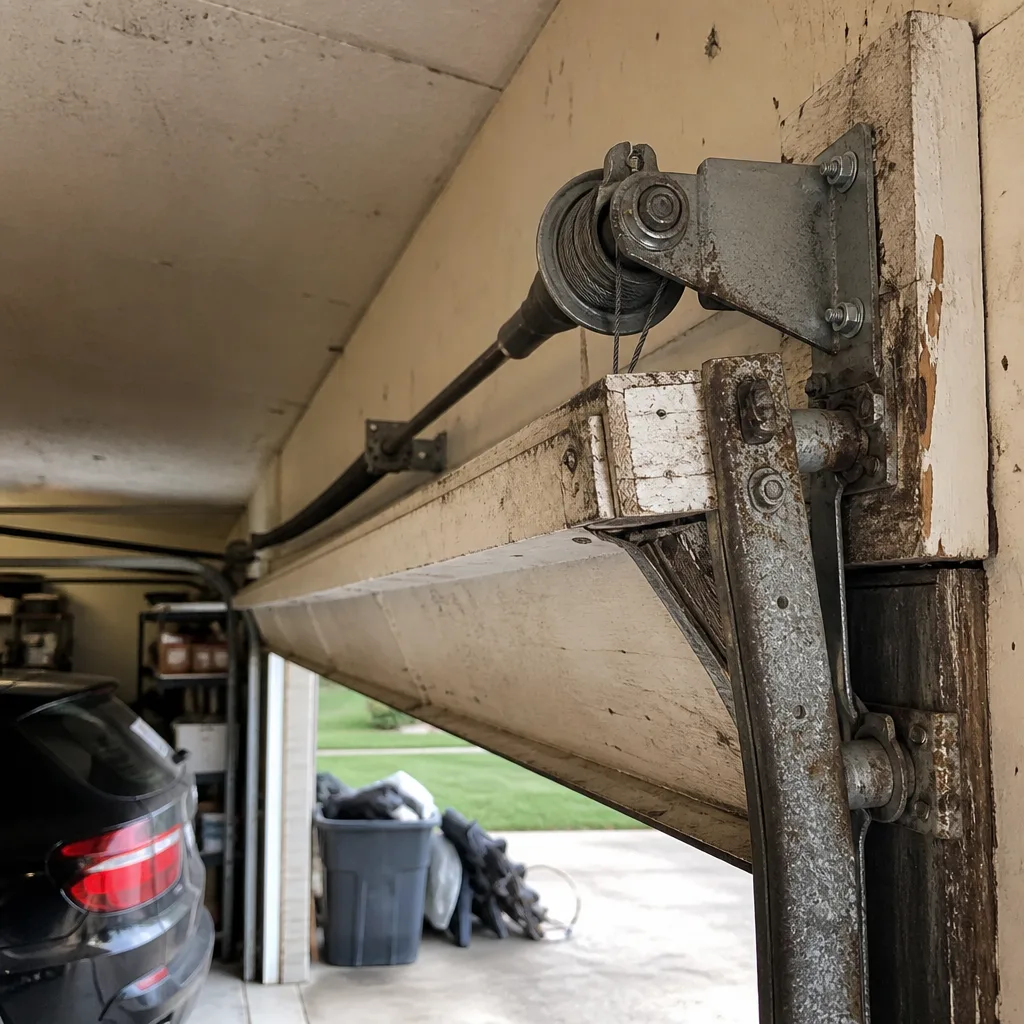
Surface rust on torsion springs is normal in Richmond’s humid climate and does not indicate imminent failure. Deep pitting, flaking, or a reddish-orange powder that wipes off to reveal pitted metal beneath does. We’ve replaced springs in Riverpark homes that showed advanced pitting after just seven years, well short of the 10-15 year typical lifespan, because the garage lacked adequate ventilation and humidity stayed above 70% year-round.
Cable rust is more serious. Cables are drawn steel, and rust reduces their cross-sectional area directly. A cable with visible rust streaking or any fraying, even if the door operates normally, should be replaced. A snapped cable under load is dangerous; the stored energy releases instantly.
Cable Slack or Uneven Winding
With the door closed, examine the cables running from the bottom brackets to the drums. They should be taut and parallel. A cable with visible slack, or one that sits in a different position on the drum than its mate, indicates a winding problem or a cable that has stretched beyond its service limit. Slack cables can jump the drum groove during operation, causing the door to drop on one side.
Spring Gap or Coil Separation
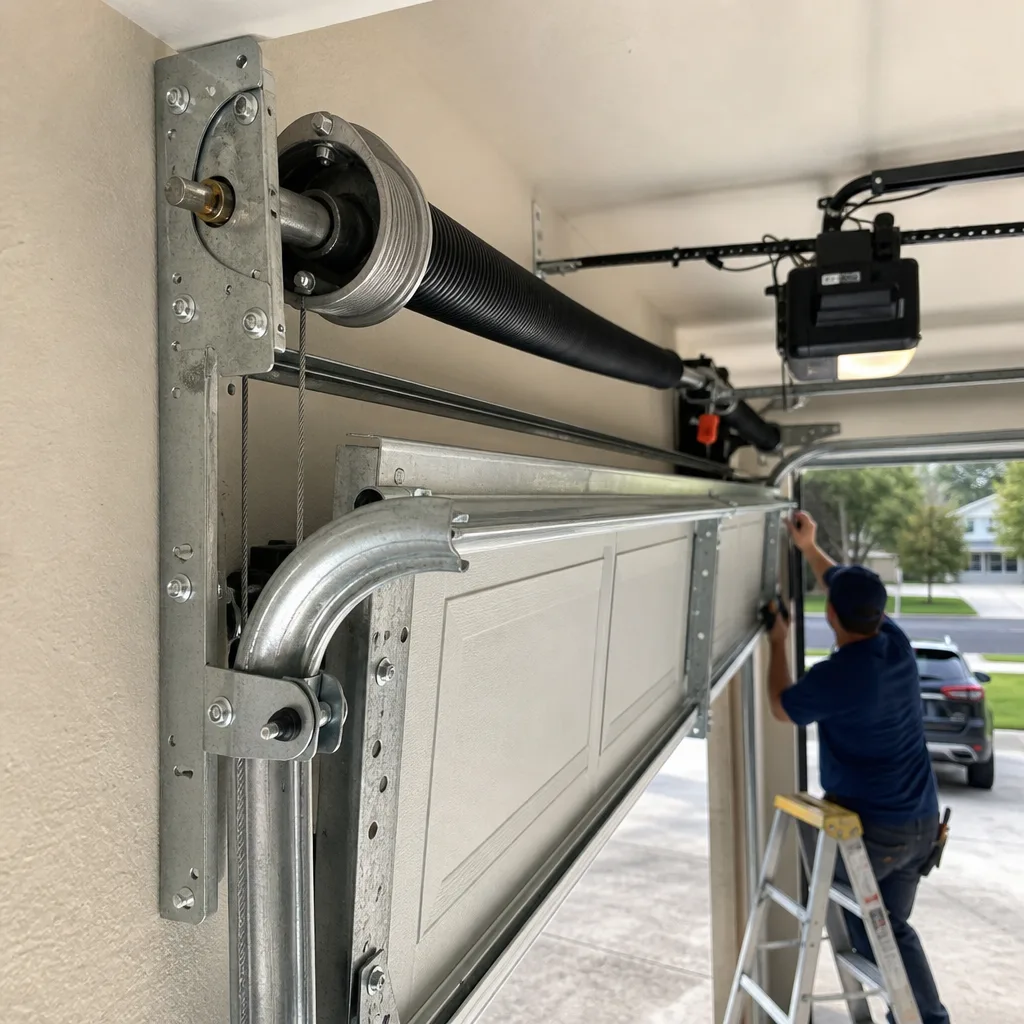
A torsion spring in good condition has coils that sit tightly together when the door is closed. A visible gap between coils, or a section where the spring appears to have “unwound” locally, indicates a broken spring. The gap may be as narrow as a finger’s width or as wide as several inches. Even a small gap means the spring has fractured internally. Do not operate the door. This is the single most important visual cue in this entire guide.
Track Alignment and Fastener Condition
Stand inside the garage with the door closed and sight along the vertical tracks. They should be plumb and parallel, with consistent spacing from the door edge at top and bottom. A track that bows inward, or fasteners that have pulled away from the wall leaving a gap behind the bracket, indicates structural stress. In Richmond, where expansive clay soils shift seasonally, we’ve seen track anchors work loose as the wall framing moves slightly. The track itself may be fine, but the mounting is compromised. A door operating on a loose track will eventually derail.
Panel Damage or Delamination
Steel doors with impact dents, especially in the lower sections, have reduced structural integrity. The dent creates a stress riser where fatigue cracking initiates. Fiberglass or vinyl doors showing delamination, where the skin separates from the core, have lost their stiffness and will sag, binding in the tracks. Wood doors with rot at the bottom edge, common in Richmond where sprinkler systems overspray against the door, absorb water and swell, then crack when they dry.
Opener Mounting and Drive Condition
Examine where the opener rail attaches to the wall above the door and where the motor unit hangs from the ceiling bracket. Cracking in the drywall around the mounting points, or visible movement of the rail when the door operates, indicates the opener is working against a loose mount. The opener strains, overheats, and fails prematurely. On chain-drive openers, sagging chain more than 1/2 inch below the rail bottom indicates wear or improper adjustment. On belt-drive units, fraying or cracking in the belt material means replacement is near. We are factory-familiar with all major brands including LiftMaster, Chamberlain, and Genie, and stock common drive components for single-visit repair.
The Safe Torsion Spring Test Every Homeowner Should Know
Torsion springs carry the full weight of your garage door. When they break, the door becomes dead weight, and the opener struggles or fails. The test below is safe because it requires no tools and no contact with the spring itself. We teach this to every Richmond homeowner who asks what they can check themselves.
- Close the door fully and engage the opener lock if equipped.
- Stand to one side of the spring tube, never directly in front of it.
- Look along the length of the spring for any visible gap between coils. A healthy spring has coils that touch or nearly touch when the door is down.
- Check for any section where the spring appears to unwind locally, creating a spiral that looks looser than the rest.
- Look for rust flaking or orange dust on the spring surface or on the floor beneath it.
- If you see any gap, unwound section, or advanced rust, do not operate the door. The spring is compromised.
Why this matters: A broken torsion spring can still allow the door to open if the opener is powerful enough. The opener is doing work it was never designed for, and the door is unsafe. The safety cables that should contain a broken spring may be absent or improperly installed, especially on older Richmond homes. When a spring breaks during operation, the door can fall freely. We’ve seen injuries from homeowners who tried to “just get the car out” with a broken spring. The flat price for spring replacement is quoted before any work begins, and most spring jobs are completed in a single visit because our trucks carry the full range of spring sizes.
Balance vs. Plumb: The 30-Second Drop Test
Homeowners often describe a door as “off balance” when the actual problem is plumb, or vice versa. The distinction matters because the repairs are different, and misdiagnosing leads to unnecessary work.
A door that is out of balance has unequal spring tension or cable length. The door feels heavier on one side, or drifts when partially open. The tracks may be perfectly straight and level, but the door itself is under unequal force.
A door that is out of plumb has tracks that are not vertical, or a door frame that is not square. The door may bind, rub on one side, or have uneven gaps at the sides. The springs and cables may be perfectly balanced, but the geometry is wrong.
The 30-second drop test separates these conditions:
- Disconnect the opener using the red emergency release.
- Lift the door manually to about three feet off the floor.
- Release it smoothly.
- Observe: Does the door stay level and drift slowly, or does one side drop faster?
- Now lower the door to about one foot off the floor and release again.
If the door stays level but drifts up or down evenly, it is out of balance (spring/cable issue). If one side drops faster, creating a visible tilt, it is also out of balance. If the door binds, rubs, or will not move smoothly through the full range even with gentle manual guidance, suspect a plumb or track alignment issue.
In Richmond, plumb problems are common in homes built during the 1980s and 1990s construction booms, where rapid framing and slab work sometimes resulted in garage openings that were not perfectly square. We’ve corrected plumb issues in Pecan Grove and First Colony where the door had been “repaired” three times for “balance” when the real problem was a 3/4-inch out-of-square frame. The fix required track realignment and custom shimming, not spring replacement. A free estimate, with the flat price stated before any work begins, prevents this kind of misdiagnosis.
Richmond-Specific Warning Signs: Humidity, Heat, and Soil
Garage doors in Richmond face conditions that doors in drier or more stable climates do not. These local factors create warning signs that generic guides never mention.
Efflorescence and Rust Streaking Near Bottom Track Anchors
White, powdery deposits on the concrete where the vertical track meets the floor, or rust streaks running down from the bottom track bracket, signal moisture wicking through the slab or collecting at the track base. In Richmond’s gumbo clay soils, poor drainage around the garage perimeter traps water against the foundation. The moisture migrates up through the concrete, carrying salts that deposit as efflorescence. The same moisture rusts the track anchor bolts from below.
This is not merely cosmetic. Rust-weakened anchors allow the track to move, and the door eventually derails or binds. In neighborhoods like Aliana and Long Meadow Farms, where finished landscaping sometimes covers original drainage patterns, we’ve seen this pattern accelerate after heavy rains. If you notice efflorescence or rust streaking at the track base, the door may still operate normally, but the structural support is degrading. Address drainage and inspect the anchors before the problem becomes mechanical.
Sun-Damaged Bottom Seals and Weatherstripping
Richmond’s south and west-facing garage doors take direct afternoon sun for six months of the year. UV exposure hardens rubber bottom seals and vinyl weatherstripping, causing them to crack and lose flexibility. A seal that has gone stiff and developed surface cracking no longer seals against water, dust, or pests. More critically, a hardened seal does not compress properly, so the door closes harder against it, stressing the opener and the bottom section. We replace hardened seals during tune-ups and recommend annual inspection for sun-facing doors.
Opener Overheating in Unventilated Garages
Richmond summer temperatures in unventilated garages routinely exceed 110 degrees. Garage door opener motors, especially older AC-motor units, have thermal cutoffs that shut them down when internal temperatures rise too high. A door that opens fine in morning cool but stalls or reverses in afternoon heat is likely suffering thermal overload. This is not a mechanical failure of the door; it is an environmental stress on the opener. Modern DC-motor openers, including many LiftMaster and Chamberlain models, run cooler and handle thermal stress better. If your opener fails only in summer afternoons, thermal overload is the probable cause.
Soil Movement and Seasonal Binding
Richmond’s expansive clay swells when wet and shrinks when dry. Garage slabs move slightly with these cycles, and doors that fit perfectly in April may bind in August after a dry summer. Binding that appears seasonally, then resolves, is almost always slab movement, not door wear. Persistent binding that worsens year over year suggests the slab is settling differentially, and the door frame is permanently out of square. We distinguish these conditions during inspection and recommend appropriate solutions, which may range from seasonal track adjustment to foundation evaluation for severe cases.
End-of-Life Wear vs. Early Failure: What Determines Your Warranty
Not every broken part is a defect. Understanding whether a failure is normal wear or premature breakdown affects whether a warranty applies and whether you’re being sold unnecessary protection. Explore more guides & resources on our blog.
Normal End-of-Life Patterns
Torsion springs have a rated cycle life, typically 10,000 cycles for standard springs. A cycle is one open-close pair. For a door used four times daily, that’s roughly seven years. Springs that break after 6-10 years of regular use have reached normal end of life. The replacement is maintenance, not defect. Warranties on springs typically cover material defects only, not cycle exhaustion.
Cables last 8-12 years under normal conditions. Fraying near the bottom bracket, where the cable bends sharply, is normal wear. Rust-related cable failure in a well-ventilated garage after 10 years is environmental wear, not defect.
Rollers wear progressively. Steel rollers lose their round profile; nylon rollers crack after UV exposure. Either failure after 8-15 years is normal.
Premature Failure Indicators
A torsion spring that breaks within three years, or a cable that frays within two, suggests improper installation or underspecification. Common causes we’ve found in Richmond include: springs wound with incorrect tension (too tight shortens life, too loose causes the opener to assist and masks the problem until the spring fatigues prematurely); wrong spring wire size for the door weight; cables that are not properly seated in the drum groove, creating a wear point; and rollers installed without lubrication at initial setup, causing immediate metal-on-metal wear.
These premature failures may be covered under workmanship warranty, depending on the original installer’s terms. Mainspring’s 90-Day Done Right Promise covers our own work in writing with no dispute process. For work done by others, we provide documentation of the failure cause for your records.
What to Document
If you believe a part failed prematurely, photograph the failed component before disposal, note the installation date if known, and keep any original paperwork. For springs, count the visible coils and measure the wire diameter with calipers if possible. This information helps determine whether the original specification was correct for your door’s weight and size. We perform this analysis at no charge during any service call.
Prevention: What Monthly Checks Actually Help
Most maintenance advice is either too vague to act on or too ambitious to sustain. These four checks, taking under 10 minutes monthly, catch the majority of problems before they become emergencies.
- Visual scan: Look for spring gaps, cable fraying, rust streaking at track anchors, and any new dents or cracks in door panels. Do this with the door closed.
- Balance test: Disconnect the opener and lift the door manually. It should move smoothly and stay at waist height when released. If it feels heavy or drifts, schedule service.
- Reversal test: With the opener connected, place a 2×4 flat on the floor centered under the door path. Close the door. It should reverse within 2 seconds of contact. If it does not, stop using the door and call for service.
- Lubrication spot-check: Apply a thin film of lithium-based grease to the roller bearings, hinge pins, and spring coils. Do not use WD-40; it attracts dust and dries to a sticky residue. In Richmond’s pollen season, wipe excess grease that has collected dust.
Avoid spraying lubricant on the tracks themselves. Clean tracks with a dry cloth if debris accumulates. Lubricated tracks attract grit and actually increase friction.
For homeowners who prefer professional maintenance, our $89 Seasonal Tune-Up includes all four checks plus spring tension verification, opener force setting confirmation, and a full hardware inspection. Most tune-ups reveal at least one developing issue that the homeowner had not noticed.
Common Mistakes to Avoid
- Ignoring a grinding sound because the door still works. Grinding means metal is being destroyed somewhere. The repair cost doubles or triples when the worn part finally fails and damages adjacent components.
- Testing the reversal feature with your hand or foot. Use a solid object like a 2×4. The safety system is designed to reverse on contact with an obstruction, not to avoid injuring you.
- Assuming a broken spring is “just one spring” on a two-spring system. Many doors have a single torsion spring. Even doors with two springs should have both replaced together; they were installed as a matched pair and have the same cycle life. Replacing one guarantees the other fails soon after.
- Adjusting opener force settings to compensate for a heavy door. This masks the underlying spring or cable problem and disables the safety system. A properly balanced door requires minimal opener force.
- DIY spring replacement. Torsion springs store lethal energy. The winding and unwinding process requires specialized tools and training. Every year, emergency rooms treat homeowners injured by springs they attempted to replace. This is not a cost-saving opportunity; it is a hazard.
- Neglecting Richmond’s humidity effects. Rust that would take 10 years to develop in Phoenix appears in 5-7 years here. Inspect more frequently than generic schedules suggest.
- Accepting a verbal estimate for major work. A square deal requires a written price before work begins. Verbal estimates leave room for “discovered” charges once the technician is on site.
When to Call a Professional
Call for same-day or emergency service if: you hear a loud pop and the door feels heavier; you see a visible gap in a torsion spring; a cable has come off the drum or shows fraying; the door fails the reversal test; or the door sags on one side, jerks violently, or drifts down after opening. These conditions present immediate safety risks.
Schedule routine service within one to two weeks for: grinding, squealing, or banging sounds; slow or hesitant operation; weatherstripping damage; or any visual rust or wear you’ve identified during monthly checks. Early intervention prevents the cascading failures that turn a $200 roller replacement into a $1,200 door rebuild.
Mainspring Garage Door Co. offers free estimates in Richmond. A live person answers every call, 24/7, including nights, weekends, and holidays. The flat price is stated before any work begins, and every completed job is covered by our 90-Day Done Right Promise in writing. Call (936) 278-3457 to schedule or to request a free second opinion on any written estimate you’ve received.
Frequently Asked Questions
Most common repairs in Richmond range from $180 for roller or cable replacement to $340 for torsion spring replacement, with opener repairs typically between $200 and $400 depending on the component. We quote the flat price before any work begins, and our $50 off any repair over $250 applies automatically. Call (936) 278-3457 for an exact quote on your specific problem - estimates are free.
No. A door with a broken torsion spring is unsafe regardless of whether the opener can still lift it. The opener is straining beyond its design limits, the door can fall without warning, and the safety system may not function correctly. Stop using the door immediately and call for emergency service. We carry springs for all major door sizes and complete most spring replacements in a single visit.
Cold-weather noise usually indicates thickened lubricant or contraction of metal components. Richmond’s occasional hard freezes into the 20s can cause standard lithium grease to stiffen, and steel tracks contract slightly, changing clearances. If the noise resolves when temperatures rise, a cold-weather lubricant switch may help. If noise persists year-round, mechanical wear is the cause and requires service.
Opener replacement is warranted when: the unit is more than 15 years old, parts are no longer available, the motor has failed internally, or you want modern safety features like rolling-code security and smartphone connectivity. Repair is appropriate for: limit switch adjustment, gear and sprocket replacement, safety sensor realignment, or circuit board issues in units under 10 years old. We are factory-familiar with LiftMaster, Chamberlain, Genie, and all major brands, and we recommend repair when it is the better value.
Richmond’s humidity, often above 80% in summer months, accelerates oxidation on unprotected steel. Rust near the floor indicates moisture wicking from the slab, common in our clay soils with poor drainage. Surface rust can be cleaned and protected; deep pitting requires track replacement. Efflorescence on the concrete near the track base confirms moisture migration and should be addressed at the source.
No. The flat price we quote before work begins is the price on the invoice. If we discover additional problems during service, we stop, explain what we found, and quote the additional work separately. You approve every charge before it is incurred. No surprises on the bill. This is how we’ve operated for 42 years.
Given Richmond’s humidity and temperature swings, annual professional service is prudent for doors in regular use. Heavy-use doors, or doors facing direct afternoon sun, benefit from inspection every 6-8 months. Our $89 Seasonal Tune-Up includes full inspection, lubrication, safety testing, and adjustment. Seniors and veterans receive a permanent 5% discount on all services.
The Bottom Line
Garage door warning signs are specific, not vague. Grinding on opening differs from grinding on closing. A pop means spring failure; squealing means bearing wear. Richmond’s humidity and soil conditions create local patterns, efflorescence at track anchors and seasonal binding, that generic advice misses. The 30-second drop test separates balance problems from plumb problems, saving you from misdiagnosed repairs. Monthly visual checks and the safe torsion spring test catch problems early, when they are simpler and less expensive to fix. When a warning sign indicates immediate danger, broken springs, failed safety systems, or detached cables, stop using the door and call for professional service. For everything else, early attention prevents the cascading damage that turns minor wear into major replacement.
Written by Carl Dutton, Owner at Mainspring Garage Door Co., serving Richmond since 2016.